
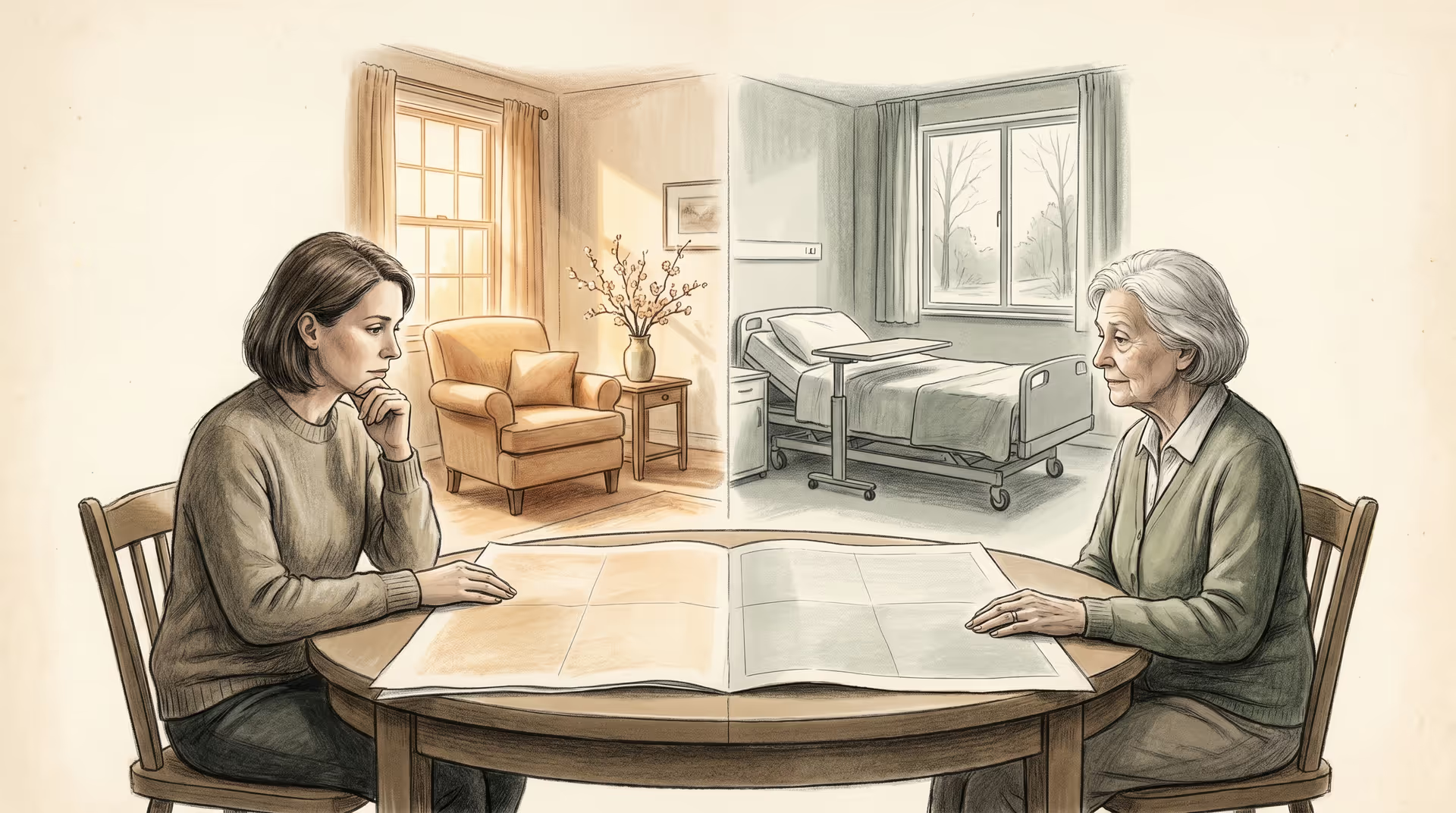
Families often use "assisted living" and "nursing home" as if they mean the same thing. They don't. They sit at different points on the care spectrum, serve different residents, and families pay for them in very different ways. Choosing the wrong one can cost you thousands of dollars a month and, more importantly, leave your loved one either under-supported or overwhelmed in a setting that's heavier than they need.
The single most important distinction is this: assisted living is a residential setting with personal care, while a nursing home (a skilled nursing facility) is a medical setting with 24-hour licensed nursing care. Everything else (staffing, environment, cost, and how each is paid for) flows from that one difference.
The fast answer: which one fits?
Reach for assisted living when your parent is largely well but needs a hand with the activities of daily living (bathing, dressing, medication reminders, meals) and would do well with company, structure, and a private apartment.
Reach for a skilled nursing facility when your parent has complex, ongoing medical needs that require licensed nurses around the clock: wound care, IV medications, feeding tubes, ventilators, or recovery from a serious surgery or stroke.
Side-by-side comparison
Below is the table we wish every family had before their first tour.
| Assisted Living | Nursing Home (Skilled Nursing Facility) | |
|---|---|---|
| Level of care | Personal care + support with daily living | 24-hour skilled medical & rehabilitative care |
| Staffing | Trained aides; nurse often on-site or on-call | Registered nurses (RNs) and licensed nurses on duty 24/7; physician oversight |
| Typical resident | Mostly independent; needs help with a few daily tasks | Chronic illness, serious mobility loss, or post-hospital recovery |
| Environment | Private apartment-style unit; home-like, social | Clinical setting; often shared rooms; hospital-like |
| Admission | You don't need a doctor's order | A physician must order admission and complete a clinical assessment |
| Regulation | Licensed and regulated state by state | Federally regulated by Medicare & Medicaid (CMS) |
| Median cost (national) | Roughly $5,000 to $6,500/month | Roughly $9,000 to $11,000/month |
| Primary way it's paid | Private pay; some Medicaid waivers; long-term care insurance | Medicare (short-term, post-hospital only); Medicaid (long-term); private pay |
Use these as rough starting points; costs in particular swing widely by region, apartment size, and how much care your loved one needs.
Level of medical care and staffing
This is where the two truly part ways.
In assisted living, the staff are caregivers rather than clinicians. They help residents stay safe and comfortable: prompting medications, assisting with a shower, getting someone to the dining room. A nurse may be on-site during the day or reachable on call, but assisted living is not built to deliver continuous medical treatment. To understand exactly what overnight coverage looks like, see our guide on whether assisted living provides 24-hour care.
In a nursing home, licensed nurses are on duty every hour of every day, with physician oversight and often physical, occupational, and speech therapists on staff. This is the right setting for someone who needs skilled nursing, meaning care that legally must be performed or supervised by a licensed professional.
The federal government, through the Centers for Medicare & Medicaid Services, sets minimum staffing and quality standards for nursing homes and publishes inspection results publicly. You can look up any facility's ratings on the government's Medicare Care Compare tool. Assisted living, by contrast, is regulated state by state, so standards vary considerably depending on where you live.
Environment and daily life
The physical difference is striking the moment you walk in.
Assisted living looks and feels like an apartment community. Residents have their own private (or semi-private) units, often with a small kitchenette, and the days are built around dining, activities, outings, and socializing. Independence and dignity are the design goals.
A nursing home looks and feels clinical. Rooms are frequently shared, common areas resemble a care unit, and the rhythm of the day revolves around medical care and therapy. That clinical feel is exactly what someone with intensive medical needs requires.
What each costs, and how it's paid for
Cost is where families get the biggest surprises, and the payment rules are the most misunderstood part of this whole comparison.
Assisted living is paid for primarily out of pocket. Most communities charge a base rate plus add-ons for higher levels of care. Some states offer Medicaid waiver programs that help cover the care portion (not room and board), and long-term care insurance may apply. For a full breakdown of the options, read how to pay for assisted living.
Nursing home payment hinges on one distinction that trips up nearly everyone:
- Medicare covers skilled nursing care only on a short-term basis, typically up to 100 days following a qualifying hospital stay, for rehabilitation or recovery. It does not pay for long-term custodial care. Medicare spells out the official rules at its long-term care page.
- Medicaid is the largest payer of long-term nursing home care in the U.S., but it is means tested, so your loved one must meet strict income and asset limits to qualify.
- Private pay and long-term care insurance fill the gaps.
The Medicare myth, in one line: Medicare does not pay for long-term assisted living or for long-term custodial nursing home stays. Plan as though long-term care is private pay until you confirm Medicaid eligibility.
How to choose between them
A few practical signals tend to point families in the right direction:
- Start with the care assessment, not the brochure. A clear-eyed assessment of what daily help your parent needs should drive the decision.
- Ask the doctor. Because a nursing home requires a physician's order, your loved one's physician is a natural partner in deciding whether your loved one meets the medical bar.
- Don't over-place. Moving a relatively independent parent into a nursing home "to be safe" often does more harm than good. Match the setting to the need.
- Plan for change. Many people start in assisted living and move to skilled nursing later. Communities that offer both levels can make that transition smoother.
- Vet quality before you sign. Whichever direction you go, learn the warning signs. Our guide on how to tell a good nursing home from a bad one walks through what to look for.
For a neutral, government overview of every long-term care setting, the National Institute on Aging's guide to long-term care facilities is an excellent starting point, and Eldercare.gov can connect you with local support.
Frequently asked questions
Is assisted living cheaper than a nursing home? Almost always, yes. Assisted living typically runs roughly half the monthly cost of a nursing home, because you're paying for personal care and housing rather than round-the-clock skilled medical care.
Does Medicare pay for assisted living? No. Medicare does not cover assisted living. It only covers short-term skilled nursing care after a qualifying hospital stay, and it never covers long-term residence in either setting.
Can someone move from assisted living to a nursing home? Yes, and many do. As medical needs increase, a move to skilled nursing is common. A physician's assessment usually guides the timing.
Does a nursing home require a doctor's approval? Yes. Because skilled nursing is a medical level of care, admission requires a physician's order and a clinical assessment. Assisted living does not.
What's the difference between a nursing home and a skilled nursing facility? They're the same thing. "Nursing home," "skilled nursing facility," and "SNF" all refer to a facility that provides 24-hour licensed nursing care.
