
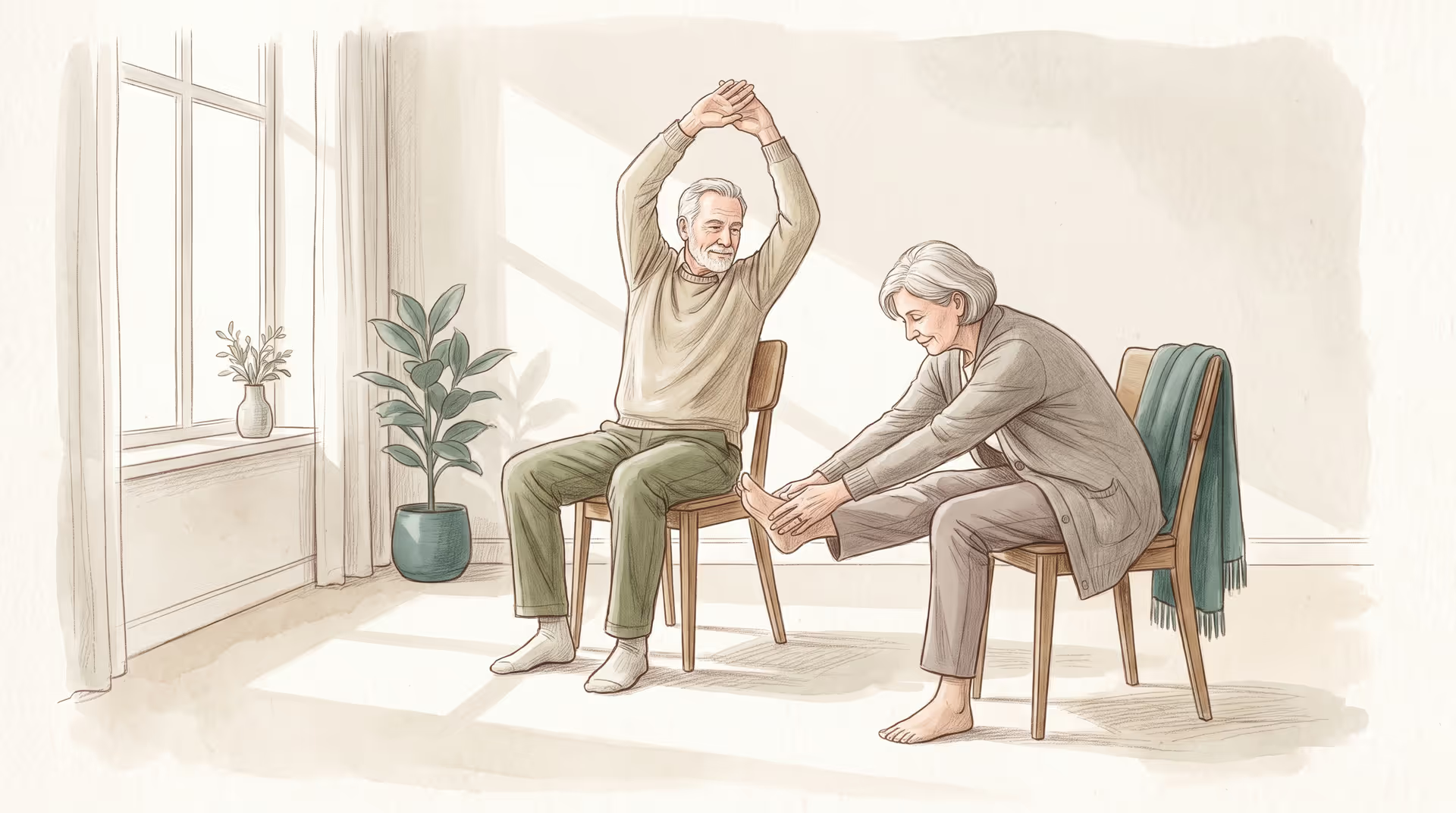
Chair yoga is a gentle, seated form of yoga that makes stretching and movement more accessible for older adults. It can be a good option for seniors who have trouble standing for long periods, who are unsteady on their feet, or who want a low-impact way to stay active. If you are arranging in‑home care for a parent, chair yoga is something a caregiver can support or join. Below are the benefits, safety tips, a short routine you can try, and practical advice for getting started.
Why chair yoga helps
Chair yoga keeps many of the benefits of regular yoga but lowers the risk of falls. Doctors and health writers from trusted sources note that chair yoga can:
- Improve flexibility and joint range of motion.
- Help maintain or build gentle strength in arms, legs, and core.
- Improve balance and mobility for people who have lower‑body joint pain.
- Lower stress and boost mood through breathing and mindful movement.
- Help with pain management and daily function for some people with osteoarthritis.
Research to date includes small studies and short programs, but results have been mostly positive. Some people experienced less pain and fatigue, and some showed better balance and function after attending chair yoga classes. Still, every person is different, and more research is needed.
Safety first
Safety matters when introducing any new exercise to an older adult.
- Use a sturdy, armless chair on a flat surface. A chair without wheels is best.
- Sit toward the front of the seat so feet can rest flat on the floor.
- Keep both feet hip‑width apart and planted firmly.
- Wear comfortable clothing and flat, non‑slip shoes or socks with grip.
- Stop any move that causes sharp pain. Mild stretch is okay, pain is not.
- If your parent has recent surgery, unstable medical issues, severe osteoporosis, or serious balance problems, check with their doctor first.
- Consider asking a physical therapist which poses are safe and helpful for specific conditions.
Quick chair yoga routine (8 simple poses)
These are easy poses to try during a short session. Do them slowly. Breathe with each movement. Hold each pose for a few breaths, then rest.
- Seated Mountain (Posture)
- Sit tall near the front of the chair.
- Feet flat, knees over ankles.
- Lengthen the spine, relax shoulders, breathe deeply.
- Overhead Stretch (Seated Crescent)
- Inhale and reach both arms overhead.
- Gently bend to one side on the exhale.
- Return to center and repeat on the other side.
- Seated Forward Bend
- Sit at the edge of the chair.
- Inhale to lengthen the spine.
- Exhale and fold forward from the hips. Let the hands reach toward the shins or the floor.
- Keep the back straight as you go down a vertebra at a time.
- Simple Seated Twist
- Sit tall and place the right hand on the left knee.
- Place the left hand on the back of the chair.
- Exhale and gently twist to look over the left shoulder.
- Repeat on the other side.
- Eagle Arms
- Extend both arms forward.
- Cross the right arm over the left at the elbows.
- Bend the elbows and try to bring palms together.
- Lift the elbows away from the chest and relax the shoulders. Swap sides.
- Chair Pigeon (Hip opener)
- Sit toward the edge of the chair.
- Lift the right ankle to rest on the left thigh, above the knee.
- Flex the right foot and sit tall. If comfortable, hinge forward slightly to deepen the stretch.
- Switch legs.
- Cat‑Cow Seated (Spine mobility)
- Sit at the edge of the chair with hands on knees.
- Inhale: arch the back, lift the chest and gaze slightly upward (cow).
- Exhale: round the back, tuck the chin and navel (cat).
- Move slowly with the breath.
- Reverse Arm Hold (Shoulder stretch)
- Sit upright with feet flat.
- Inhale and open the arms wide.
- Exhale and reach the hands behind the back, bending the elbows slightly.
- Gently lift the chest to feel a shoulder stretch.
You can do a short session of three to eight poses, or go through the whole set. Even five to ten minutes of movement can help reduce stiffness.
How often and how to progress
Start slow. Try 2–3 short sessions a week. Pay attention to comfort and energy levels. Some community programs use twice-weekly classes and show benefits. As your parent grows more confident, sessions can be lengthened or repeated more often. Encourage steady breathing and good posture rather than depth or speed of the poses.
Tips for caregivers and family
- Join in. Doing the routine together can be safer and more motivating.
- Make the space clear of rugs, cords, and clutter.
- Place a glass of water and a phone nearby.
- Use a cushion for extra seat height if leaning forward is hard.
- Offer gentle reminders about breathing and alignment.
- Consider online chair yoga videos or local classes aimed at older adults.
- Track comfort and any changes in pain or mobility. Share concerns with the healthcare team.
When to check with a healthcare provider
Talk to the doctor before starting if your parent has:
- Uncontrolled blood pressure or heart issues.
- Recent fractures, surgery, or severe osteoporosis.
- Advanced balance or neurologic conditions.
- New or worsening pain during movement.
A physical therapist can suggest specific modifications and safe progressions.
Final thoughts
Chair yoga is an accessible way to keep an aging parent moving. It reduces the need to stand or get on the floor. It can help with flexibility, balance, and mood. Start slowly, keep safety first, and involve caregivers. Small, consistent steps often make the biggest difference. If you need help finding in‑home support to set up safe exercise time, a home‑care provider can help coordinate routines and supervise sessions.
