
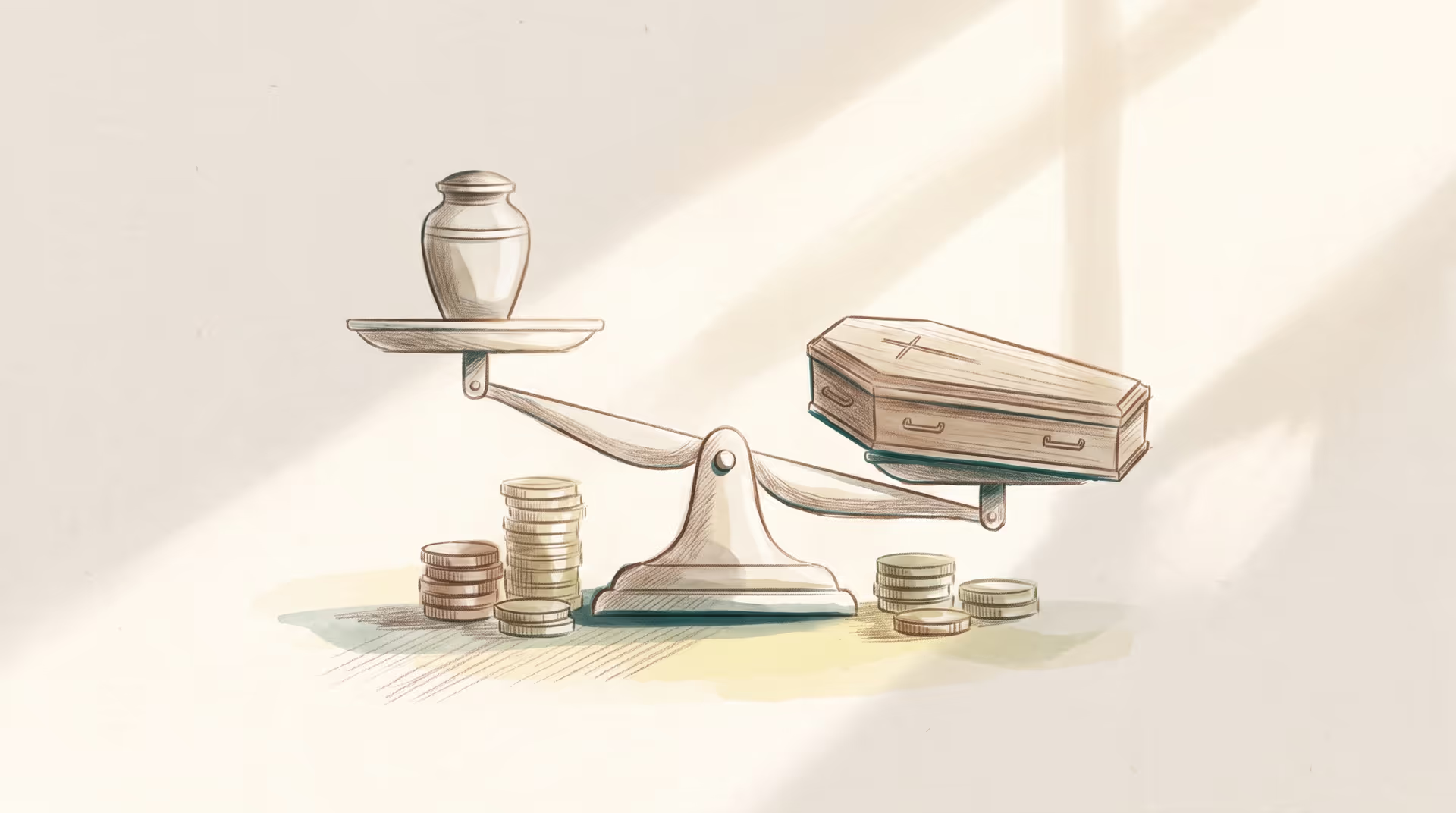
Deciding between cremation and burial is both practical and personal. Many adult children worry about cost while honoring a parent’s wishes. This article lays out the main differences, typical price ranges, and ways to save. Read it to get clear, usable information before you call funeral providers.
How cremation and burial differ
Cremation reduces a body to ashes. The result is an urn or another container that you can keep, scatter, or bury later. Cremation offers timing flexibility. You can hold a service before or after the cremation.
Burial means a casket is placed in the ground. It usually involves a gravesite, a headstone, and a graveside service. Burials tend to follow a tighter timeline because people want family and friends to attend.
Both options can include a full memorial service, viewings, or a simple unattended option. The choices you make drive the final cost more than the method itself.
Typical cost ranges (U.S.)
Prices vary by state and by provider. Below are commonly reported ranges from industry sources.
- Direct cremation (no viewing or service): roughly $700 to $3,500. This is the lowest-cost option and usually includes transportation, the cremation itself, and a basic container.
- Cremation with a memorial or viewing: about $2,000 to $7,000. A full-service cremation that includes embalming, a viewing, and a ceremony can cost more.
- Traditional burial with viewing and a casket: commonly $7,000 to $10,000 or more.
- Burial with a vault, cemetery plot, and marker: can raise the cost by several thousand dollars; some cemetery costs alone may be $1,000 to $5,000 or higher depending on location.
These ranges are broad because local prices and the services you choose make the biggest difference.
What drives the cost
Here are the main items that add to the total bill.
For cremation:
- Basic services fee from the funeral home (coordination, paperwork).
- Transportation of the body to the facility.
- Cremation fee charged by the crematory.
- Cremation container and urn.
- Optional embalming, viewing, facility rental, printed programs.
For burial:
- Funeral home basic services and transportation.
- Embalming and preparation for open-casket viewings.
- Casket (often one of the largest single costs).
- Cemetery plot purchase.
- Opening and closing of the grave.
- Burial vault or liner (many cemeteries require this).
- Headstone or marker.
Even a cremation can become costly if you choose a high-end urn, a funeral home viewing with embalming, and a full-service memorial.
Why cremation is often cheaper
Cremation usually removes the need for three big expenses: a casket, a cemetery plot, and a burial vault. That’s why direct cremation is generally far less expensive than a full burial. However, if you add the same services to a cremation (embalming, viewing, venue rental), the cost gap narrows.
Regional cost differences also matter. Urban areas and states with higher living costs tend to charge more for both cremation and burial.
Watch for surprising or hidden fees
Some common surprises families report:
- Basic services or administrative fees that look non-negotiable.
- Charges for transportation from the place of death.
- Fees for obtaining certified death certificates (often $10–$20 each).
- Costs for a rental casket if you want an open-casket viewing before cremation.
- Cemetery fees for opening and closing or for placing an urn in a niche.
The Federal Trade Commission (FTC) requires funeral providers to give you an itemized price list when you ask. Ask for that General Price List and compare providers before you decide.
Practical ways to save money
- Consider direct cremation if a simple option fits your family’s wishes.
- Shop around. Compare prices from funeral homes and independent crematoriums.
- Ask for the General Price List (FTC rule) and get quotes by phone.
- Hold a memorial at home, at a community center, or at a place of worship instead of renting a funeral home space.
- Choose a basic urn or keep ashes in a temporary container until you find the right permanent option.
- If burial is important, compare cemetery plots and ask about opening/closing and vault rules up front.
- Check for veterans benefits. Some veterans and eligible family members qualify for burial allowances or other help.
Making the choice
Cremation often costs less than burial, especially when you choose direct cremation. But cost is only one part of the decision. Religious beliefs, family traditions, and the desire for a permanent gravesite also matter. If your parent expressed wishes, use those to guide you.
If you’re arranging care or planning ahead for an aging parent, talk about options now. Pre-planning can let your parent state preferences and lock in prices in some cases. It also eases decision-making for you later.
Quick checklist before you call
- Know whether your loved one wanted burial or cremation.
- Decide what level of service you want: direct, memorial, or full service.
- Have a budget range ready.
- Ask providers for the General Price List and compare at least two.
- Ask about what’s included and what is extra (urns, certificates, transport, cemetery fees).
- Check for any veteran or other benefits that may apply.
If you take these steps, you’ll make a clearer choice that fits both your family’s needs and your budget. If you want a short list of local providers or help comparing quotes, we can help you find trusted options near you.
